The Origin of Capitalism by Ellen Meiksins Wood
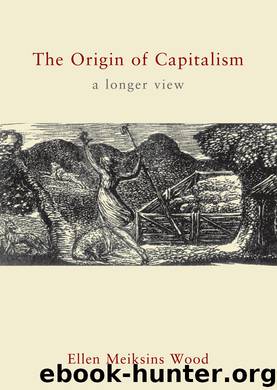
Author:Ellen Meiksins Wood [Wood, Ellen Meiksins]
Language: eng
Format: epub
Publisher: Verso Books
Published: 2016-02-08T05:00:00+00:00
ENCLOSURE
This brings us to the most famous redefinition of property rights: enclosure. Enclosure is often thought of as simply the fencing in of common land, or of the ‘open fields’ that characterized certain parts of the English countryside. But enclosure meant not simply a physical fencing of land but the extinction of common and customary use rights on which many people depended for their livelihood.
Early enclosures were sometimes undertaken by, or with the agreement of, smaller fanners and not always to their detriment. But the first major wave of socially disruptive enclosure occurred in the sixteenth century, when larger landowners sought to drive commoners off lands that could be profitably put to use as pasture for increasingly lucrative sheep farming. Contemporary commentators held enclosure, more than any other single factor, responsible for the growing plague of vagabonds, those dispossessed ‘masterless men’ who wandered the countryside and threatened social order.7 The most famous of these commentators, Thomas More, though himself an encloser, described the practice as ‘sheep devouring men’. These social critics, like many historians after them, may have overestimated the effects of enclosure at the expense of other factors leading to the transformation of English property relations. But it remains the most vivid expression of the relentless process that was changing not only the English countryside but also the world: the birth of capitalism.
Enclosure continued to be a major source of conflict in early modern England, whether for sheep or increasingly profitable arable farming. Enclosure riots punctuated the sixteenth and seventeenth centuries, and enclosure surfaced as a major grievance in the English Civil War. In its earlier phases, the practice was to some degree resisted by the monarchical state, if only because of the threat to public order. But once the landed classes had succeeded in shaping the state to their own changing requirements – a success more or less finally consolidated in 1688, in the so-called ‘Glorious Revolution’ – there was no further state interference, and a new kind of enclosure movement emerged in the eighteenth century, the so-called ‘Parliamentary enclosures’. In this kind of enclosure, the extinction of troublesome property rights that interfered with some landlord’s powers of accumulation took place by acts of Parliament. Nothing more neatly testifies to the triumph of agrarian capitalism.
Download
This site does not store any files on its server. We only index and link to content provided by other sites. Please contact the content providers to delete copyright contents if any and email us, we'll remove relevant links or contents immediately.
International Integration of the Brazilian Economy by Elias C. Grivoyannis(111078)
The Radium Girls by Kate Moore(12036)
Turbulence by E. J. Noyes(8057)
Nudge - Improving Decisions about Health, Wealth, and Happiness by Thaler Sunstein(7712)
The Black Swan by Nassim Nicholas Taleb(7137)
Rich Dad Poor Dad by Robert T. Kiyosaki(6646)
Pioneering Portfolio Management by David F. Swensen(6305)
Man-made Catastrophes and Risk Information Concealment by Dmitry Chernov & Didier Sornette(6029)
Zero to One by Peter Thiel(5808)
Secrecy World by Jake Bernstein(4756)
Millionaire: The Philanderer, Gambler, and Duelist Who Invented Modern Finance by Janet Gleeson(4483)
The Age of Surveillance Capitalism by Shoshana Zuboff(4310)
Skin in the Game by Nassim Nicholas Taleb(4257)
The Money Culture by Michael Lewis(4212)
Bullshit Jobs by David Graeber(4197)
Skin in the Game: Hidden Asymmetries in Daily Life by Nassim Nicholas Taleb(4012)
The Dhandho Investor by Mohnish Pabrai(3776)
The Wisdom of Finance by Mihir Desai(3754)
Blockchain Basics by Daniel Drescher(3586)
